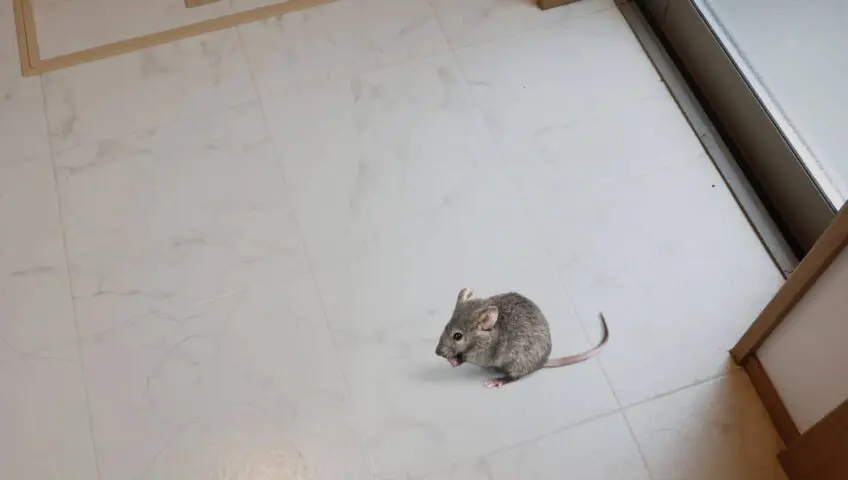
Florida’s warm climate and year-round humidity are great for living on the Space Coast, but they also make the state unusually hospitable to mice. Unlike homeowners in colder states who get a seasonal break from rodent pressure, Brevard County residents deal with several active types of mice in January just as much as in July. There is no off-season here.
Most people assume a mouse is just a mouse, but the species matters. Different types of mice behave differently, nest in different places, and require different control strategies. Knowing what you are actually dealing with is the first step toward getting rid of it for good.
Why Several Types of Mice Are a Year-Round Problem
Florida’s subtropical climate means several types of mice breed and stay active all year long. A single female house mouse can produce up to ten litters per year, each with five to six pups. Multiply that across a colony that has found its way into your walls, and the problem escalates fast.
Florida homes also give mice a lot of ways to get in. Older construction tends to have more gaps around pipes, utility lines, and weathered trim. Dense landscaping, mulched beds near the foundation, and mature trees throughout Brevard County’s neighborhoods all create easy pathways from the yard to the inside of a home.
The Types of Mice Most Commonly Found in FL Homes
Several mouse species are active in and around Brevard County homes, but they are not all the same problem. Some are highly adapted to living alongside people and will move in at the first opportunity.
Others are native species that wander in from nearby natural areas under the right conditions. Here is a breakdown of the ones local homeowners encounter most often.
House Mouse
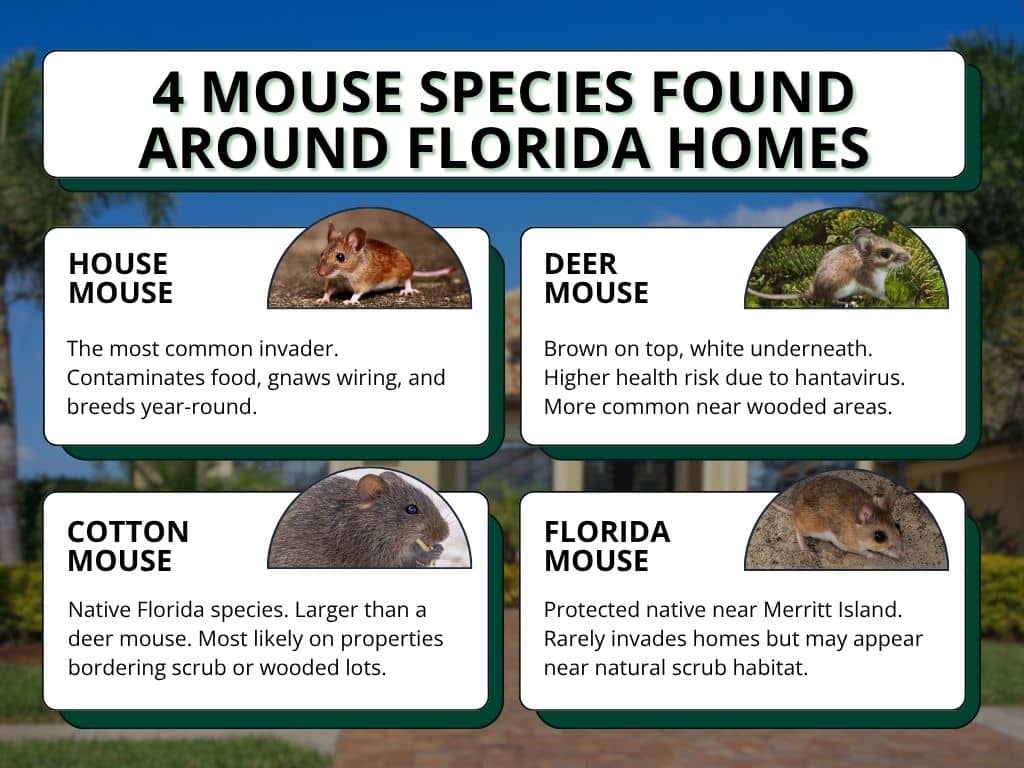
The house mouse is not originally native to Florida, but has become one of the most common species found in Florida homes.
Small, typically gray-brown with a lighter underside, and highly adaptable to human environments, these are the mice most homeowners are dealing with when they find droppings in a cabinet or hear scratching in the walls at night.
House mice are not picky eaters. They contaminate far more food than they actually consume, leaving behind droppings and urine that create health risks and persistent odor problems. Known carriers of Salmonella and other pathogens. They are also prolific gnawers, and chewed electrical wiring inside wall cavities is a documented cause of residential fires.
- Where they nest: Wall voids, attic insulation, kitchen cabinets, behind appliances, garages
- What brings them in: Accessible food, open trash, gaps in the structure
- Threat level: High, health risks, structural damage, rapid reproduction
Deer Mouse
Deer mice are types that are more common in rural and wooded areas, but do find their way into homes, particularly during drier or cooler stretches. They are identifiable by their two-toned coloring: brown on top, white on the underside, with notably large eyes and ears.
The deer mouse carries a higher health concern than the house mouse because it is a known carrier of hantavirus, which can be transmitted to humans through contact with droppings, urine, or saliva. In Brevard County, homes near scrub habitat, open fields, or wooded buffer zones carry more risk of deer mouse activity than homes in dense suburban areas.
- Where they nest: Garages, sheds, wall voids, stored boxes, and equipment
- What brings them in: Proximity to natural areas, food scarcity, structural gaps
- Threat level: High due to hantavirus risk
Cotton Mouse
Cotton mice are native to Florida and are more common in rural and forested parts of the state. They look similar to deer mice but tend to be slightly larger and stockier, with soft brown fur and a white underside. They are skilled climbers and will enter homes or outbuildings near wooded lots when they get the opportunity.
In Brevard County, cotton mice are most likely to show up in homes that border natural scrub, undeveloped land, or heavily wooded lots. They are not as aggressively domestic as house mice but will exploit an opening when one exists.
- Where they nest: Garages, sheds, storage areas, wall voids near wooded lots
- What brings them in: Adjacent natural habitat, structural gaps, food access
- Threat level: Moderate
Florida Mouse
The Florida mouse is a native species with a notable population on Merritt Island, right here in Brevard County. It is primarily a burrowing species that lives in sandy scrub habitats and carries state-level conservation status as a species of special concern.
Florida mice are not typical home invaders, the way house mice are. However, habitat changes and development pressure have pushed them closer to residential areas in some parts of the county. Homes near Merritt Island scrub or properties along the natural areas bordering the Indian River Lagoon corridor are the most likely to encounter them.
- Where they nest: Primarily outdoors in sandy soil; occasionally in low structural gaps
- What brings them in: Habitat disruption, proximity to natural scrub
- Threat level: Low as a structural pest
Quick ID Comparison
|
Species |
Appearance |
Most Common Entry |
Primary Risk |
|
House Mouse |
Gray-brown, small, pointed snout |
Foundation gaps, doors, pipes |
Disease, gnawing damage |
|
Deer Mouse |
Two-toned brown and white |
Garages, sheds, rural structures |
Hantavirus |
|
Cotton Mouse |
Brown with white underside, stockier |
Wooded lot adjacency, outbuildings |
Contamination |
|
Florida Mouse |
Sandy brown, large eyes |
Scrub-adjacent properties |
Low structural risk |
How Do Mice Get Into Florida Homes?
Most types of mice do not need much space. A gap the size of a dime is enough for a house mouse to squeeze through. Common entry points include gaps around pipe penetrations through walls or foundations, deteriorated weatherstripping under garage and exterior doors, openings around utility and cable lines, gaps in rooflines or soffits, and cracks in older block construction.
Once inside, most types of mice follow warmth and the scent of food. Kitchens, laundry rooms, and garages are the first areas to see activity. From there, they move into wall voids and attics, where they feel secure enough to nest and reproduce.
Signs You Have Mice
You are unlikely to see a mouse during the day in the early stages of an infestation. What you will notice first are the signs they leave behind:
- Droppings: Small, dark, pellet-shaped, found near food sources, along baseboards, or inside cabinets
- Gnaw marks: Fresh bite marks on food packaging, wood trim, or wiring
- Nesting material: Shredded paper, fabric, or insulation gathered in a quiet corner or wall void
- Grease marks: Dark smudges along baseboards where mice travel the same path repeatedly
- Scratching sounds: Especially at night, coming from walls, ceilings, or under cabinets
Finding droppings in multiple locations usually means an established infestation, not a single stray mouse.
Prevention Tips for Brevard County Homes
Effective prevention means removing what attracts mice and closing off what lets them in:
- Seal structural gaps: Focus on pipe penetrations, the garage door threshold, and anywhere materials meet. Steel wool packed into openings before caulking or foaming deters gnawing.
- Pull mulch back from the foundation: Deep mulch holds moisture and gives mice excellent cover right at the base of your home.
- Store food in sealed containers: Pet food and birdseed are just as attractive to mice as pantry staples.
- Manage vegetation near the structure: Overhanging branches and shrubs touching the exterior give mice direct access to rooflines and soffits.
- Reduce clutter in garages and sheds: Stacked boxes and stored equipment are ideal nesting spots, especially for species coming in from adjacent natural areas.
Homes near scrub habitat, Merritt Island, or the rural edges of Brevard County face higher baseline pressure from native species and benefit from staying ahead of prevention year-round.

Related Questions
Do rats and mice require different treatment approaches?
Yes. Rats and several types of mice behave differently, nest in different areas, and respond to different baiting and exclusion strategies. Accurate species identification is always the starting point for an effective rodent control plan.
How does rodent activity connect to other pest problems?
Rodents and other pests often share the same conditions: moisture issues, structural gaps, dense ground cover, and accessible food. Addressing what attracts one pest tends to reduce the environment that supports others as well.
Can existing pest or termite damage make it easier for mice to get in?
Yes. Termite damage, wood rot, and pest-related structural deterioration can create or enlarge the entry points mice use to access a home. This is one reason a full pest inspection looks at the complete picture rather than a single problem in isolation.
What role does lawn condition play in rodent pressure?
Overgrown turf, dense ground cover, and unkempt landscaping near the home all provide cover and nesting opportunities for mice. A well-maintained lawn with vegetation pulled back from the foundation is meaningfully less hospitable to rodents than one with heavy growth against the structure.
When to Call a Professional
DIY trapping can reduce individual mice of all types, but does not address an established colony, eliminate nesting sites inside the structure, or seal the entry points that let mice in to begin with. If any of the following apply, it is time to bring in a professional:
- You are finding droppings in multiple rooms or areas of the home
- You are hearing scratching or movement in walls, ceilings, or attic spaces at night
- Traps are catching mice repeatedly, but the signs of activity are not going away
- You have found a nest or nesting material inside the home
- You are near scrub habitat or wooded land and want to get ahead of pressure from native species before an infestation establishes
Slug-A-Bug’s rodent control team has been serving Brevard County since 1982. We know the species active in this part of Florida, the entry points common to local construction, and the treatment strategies that get lasting results. If mice are getting in, we can find out how, stop it, and keep it from happening again.
Conclusion
Florida’s climate makes several types of mice a year-round concern, not a seasonal one. Knowing which species you are dealing with, whether it is a house mouse in your kitchen cabinets or a deer mouse coming in from a wooded lot, puts you in a much better position to respond effectively.
Prevention goes a long way: sealing gaps, managing landscaping, and eliminating food access are habits that pay off consistently. When those steps are not enough, professional identification and treatment make the difference between a temporary fix and a lasting one.
Reach out to the Slug-A-Bug team for service and professional guidance today
