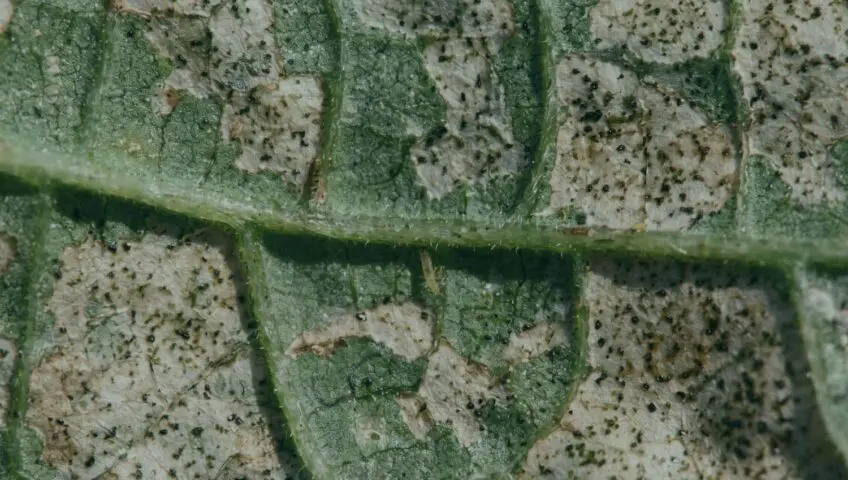
Thrips on plants leave silvery streaks, bronzed new growth, curled leaves, and tiny black specks of waste on the foliage. The insect itself is roughly the width of a pencil line, so most Brevard County homeowners notice the damage weeks before they notice the bug.
One thing to get straight early: thrips are a landscape and ornamental pest, not a lawn pest. They feed on roses, crape myrtle, viburnum, gardenia, and mandevilla, not on St. Augustine grass. Two risks make them worth acting on quickly. Some species spread plant viruses that have no cure, and a few species will bite people when they swarm.
How To Spot Thrips on Plants
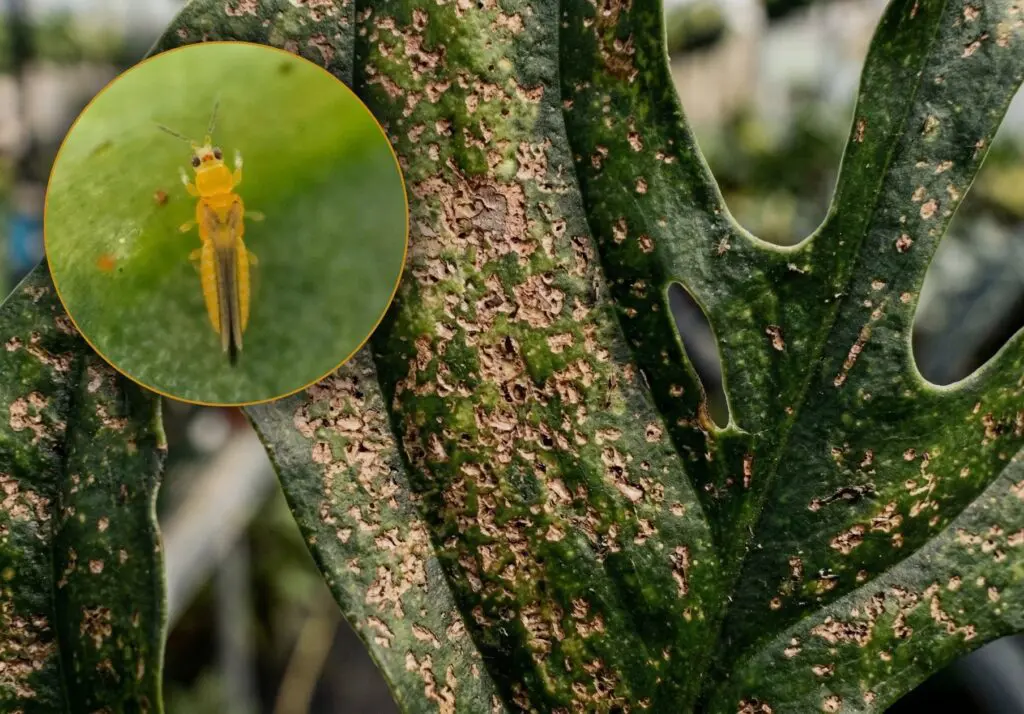
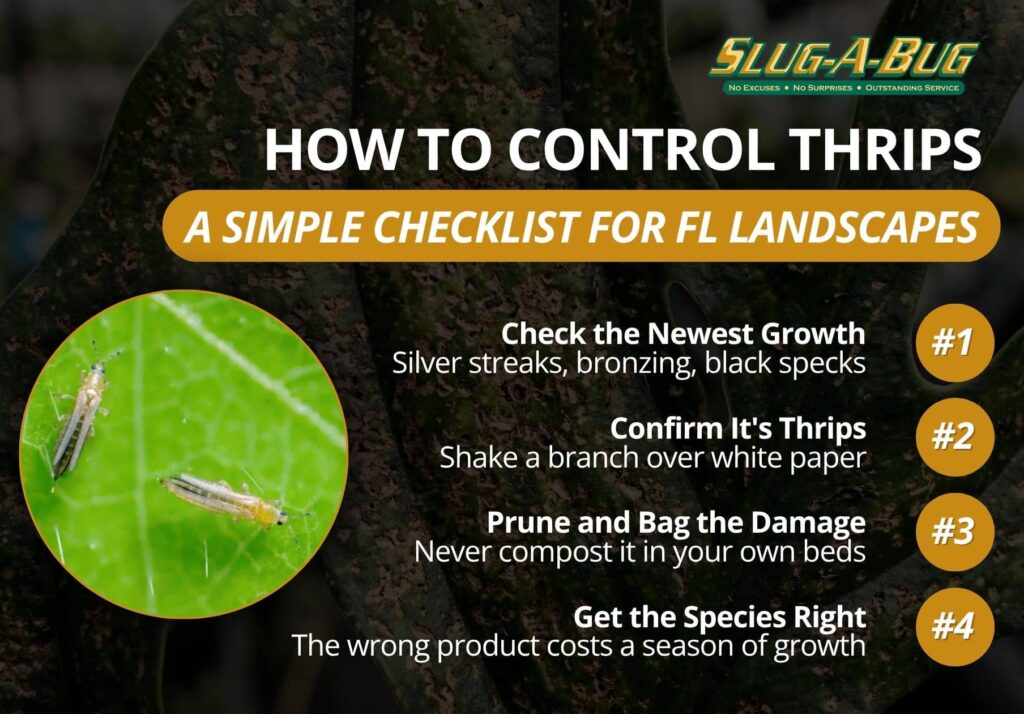
Look at the newest growth first. Thrips feed by puncturing plant cells and drinking what comes out, which kills the tissue and leaves behind a scarred, discolored surface. That pattern shows up on tender leaves and flower petals long before it reaches mature foliage.
What the Damage Looks Like
- Silvery or whitish streaking on leaf surfaces, sometimes with a metallic sheen
- Bronze or coppery discoloration on new leaves and buds
- Leaves curling upward and looking puckered or distorted
- Tiny black specks scattered across the leaf, which is thrips waste and the clearest single giveaway
- Flower petals with brown streaks or buds that never open properly
- Stunted new growth, or leaves dropping with the stem still attached
Rose growers in Melbourne and Palm Bay often describe the look as scorched or burned, as though the plant got hit with too much fertilizer. That burned appearance on a Knock Out rose is one of the most common thrips calls we get.
How To Confirm You Have Thrips
Hold a sheet of white paper under an affected branch and shake it. Thrips will drop onto the paper and start moving almost immediately. They look like slivers of rice with legs, pale yellow to dark brown depending on species, and they move fast for something that small. A hand lens helps, but the movement alone is usually enough.
Check three or four branches on different sides of the plant rather than one. Populations cluster, so a single clean sample does not clear the plant.
If nothing moves and you only see fine webbing, you are dealing with spider mites instead. If the specks on the paper hop, those are likely springtails and harmless to the plant.
Which Thrips Show Up in Brevard County Landscapes
Most gardening articles treat thrips as a single insect. Florida has several that behave differently, and the species changes both what the damage looks like and what actually controls it.
| Species | Common hosts here | What the damage looks like |
|---|---|---|
| Chilli thrips | Roses, crape myrtle, viburnum, Indian hawthorn, camellia, Japanese holly | Bronzing and upward curl on new growth, stunted plants, leaf drop |
| Thrips parvispinus | Gardenia, mandevilla, dipladenia, anthurium | Silver scarring on fully developed leaves |
| Florida flower thrips | Flowering shrubs, citrus, annual beds | Streaked petals, distorted blooms |
| Western flower thrips | Wide range of ornamentals and vegetables | Stippling, scarring, and virus symptoms |
Chilli thrips is the one that surprises people. According to UF/IFAS Extension, it feeds on more than 100 plant species and targets new growth specifically, so the classic silver stippling that national guides describe is often absent. You get bronzing instead.
Thrips parvenus was first detected in the United States right here in Florida, and it hits gardenia and mandevilla hard. Its damage mimics broad mite injury closely enough that the two get confused, with one useful difference: broad mites stay on new growth, while this thrips scars mature leaves too.
The Risks Beyond Cosmetic Damage
Leaf scarring is the visible problem. Two less visible ones matter more.
Plant Viruses Have No Cure
Western flower thrips spreads a group of plant viruses that includes tomato spotted wilt virus, impatiens necrotic spot virus, and tomato chlorotic spot virus. UF/IFAS research has specifically associated tomato chlorotic spot virus transmission with thrips in Florida.
Once a plant is infected, no treatment reverses it. You can control the insect, but you cannot cure the plant. That is the honest argument for treating a thrips problem early rather than waiting to see whether the plant grows out of it, because a heavy population in your beds raises the odds that something in the landscape picks up a virus it will not recover from.
Thrips Do Bite People
Plenty of gardening sites state flatly that thrips are harmless to humans. The published record says otherwise. UF/IFAS documents that Florida flower thrips bite people when swarming, and that the bites cause skin irritation without transmitting any disease.
A review in Florida Entomologist found this species was the only thrips documented biting people in Florida across a twelve-year study window, with reactions ranging from slight irritation to an itchy rash lasting several days.
Researchers also found that people in white or blue clothing were bitten more often, which matches how thrips respond to those colors on monitoring traps. So if you get prickly sensations while pruning in a white shirt on a spring afternoon, you are not imagining it.
What Actually Works Against Florida Thrips
Two pieces of common internet advice work against you here.
Soil drenches and beneficial nematodes. These rest on the idea that thrips drop to the soil to pupate. Many species do. Chilli thrips does not: UF/IFAS notes its pupae stay on the plant, in leaf litter, in leaf axils, and inside curled leaves. Treating the soil misses the species Florida homeowners most often have.
Pyrethrin and pyrethroid sprays. These lead most national how-to articles. UF/IFAS states that pyrethroids have never been reported to provide effective control of chilli thrips. A homeowner following that advice often reaches for the one chemistry class documented not to work.
What Holds Up Reliably
- Prune out and bag the damaged growth. Do not compost it on site.
- Treat on a repeat schedule. Thrips insert their eggs inside plant tissue, where no contact spray reaches them. A single application kills the adults and leaves the next generation intact.
- Use blue sticky cards to monitor, not to control. They tell you whether the population is rising, which tells you whether the treatment is working.
- Clear weeds and leaf debris from beds, which removes both hosts and pupation sites.
- Match the product to the species. This is where a licensed applicator earns the fee, since the effective materials for chilli thrips are largely restricted-use or professional-grade.
Timing matters in Brevard. Thrips never fully shut down here the way they do in northern states, and populations peak in spring and summer and flare during hot, dry stretches and after a pruning flush pushes out tender new growth.
Related Questions To Explore
Do Thrips Go Away on Their Own?
Rarely, in Central Florida. Northern gardens get a winter break that knocks populations down. Here the generations keep overlapping, so an untreated infestation on a rose or gardenia usually persists until something interrupts it.
Will My Plant Recover From Thrips Damage?
Scarred leaves never heal, but the plant usually pushes clean new growth once feeding stops. Prune the damaged tissue and judge recovery by the new flush. The exception is a plant infected with a thrips-vectored virus, which will not recover.
Does Neem Oil Kill Thrips?
It kills the ones it directly contacts, and it does nothing to eggs sitting inside leaf tissue. Neem can help on a small houseplant with repeat applications. On an established landscape infestation, it usually just delays real treatment.
What Is the Difference Between Thrips and Spider Mites?
Spider mites leave fine webbing and a dusty, evenly stippled look. Thrips leave streaks, bronzing, and black specks of waste, with no webbing. Both cause pale, tired-looking foliage, which is why the wrong pest gets treated so often.
Where Do Thrips Come From?
Most landscape infestations arrive on a new plant. Nursery stock and big-box garden center plants are the most common route, which is why it pays to inspect the newest leaves before anything goes into a bed. Thrips also drift in on the wind from neighboring yards and move up from weeds and spent annuals once those hosts dry out.
Are Thrips the Same as Whiteflies?
No. Whiteflies are larger, obvious in flight when you disturb a shrub, and they leave sticky honeydew and sooty mold. Thrips leave no honeydew at all, so a shrub with a black, greasy film has a whitefly or scale problem rather than thrips.
When To Call a Professional
Bring in a licensed technician when the damage keeps appearing on new growth after you have treated it, when more than one plant type in the landscape is affected, or when the plants involved are roses, gardenias, mandevilla, or mature crape myrtle that would be expensive to replace.
Species identification is the reason. The right treatment for chilli thrips is different from the right treatment for Thrips parvenus, and both differ from what works on aphids or scale insects. Getting that wrong costs a season of growth.
You also want a professional when you are unsure whether you are looking at insect damage or disease. Bronzing, curling, and yellowing show up with nutrient problems and root issues too, and a technician who inspects the whole landscape sorts that out in one visit.

Conclusion
Thrips damage tends to be well underway by the time it catches your eye, and in a Brevard landscape it rarely resolves without help. Check the new growth on your roses and flowering shrubs, shake a branch over white paper, and look for those black specks.
Slug-A-Bug has treated Brevard County landscapes since 1974, and thrips are covered under our ornamental shrub and palm program alongside aphids, scale, mealybugs, and leafminers. Reach out, and we will identify what is feeding on your plants and build a treatment schedule around it.