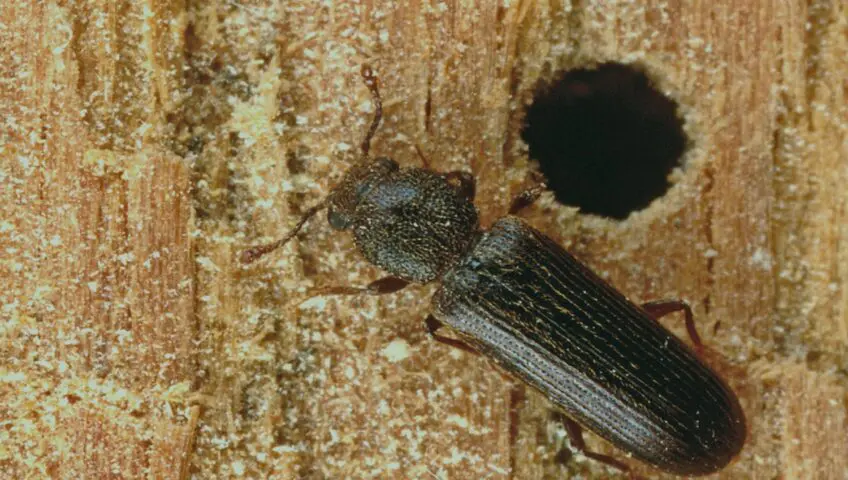
Powderpost (or powder post beetles) are small wood-boring insects whose larvae eat through wood and leave behind fine powder and round exit holes. Prevention depends entirely on which of the three families you have, because two of them arrive in your house completely differently.
One group comes in already living inside lumber or furniture you brought home. The other is a moisture problem in wood you already own. Same holes, same powder, two different fixes. Here is how to tell them apart.
Why You See the Damage Before the Beetle
The adults are only an eighth to a quarter inch long, and they spend almost no time in the open. Nearly everything happens out of sight. Eggs are laid on bare wood, the larvae hatch and tunnel through it for months or sometimes years, and the first thing most homeowners see is the hole an adult made on its way out.
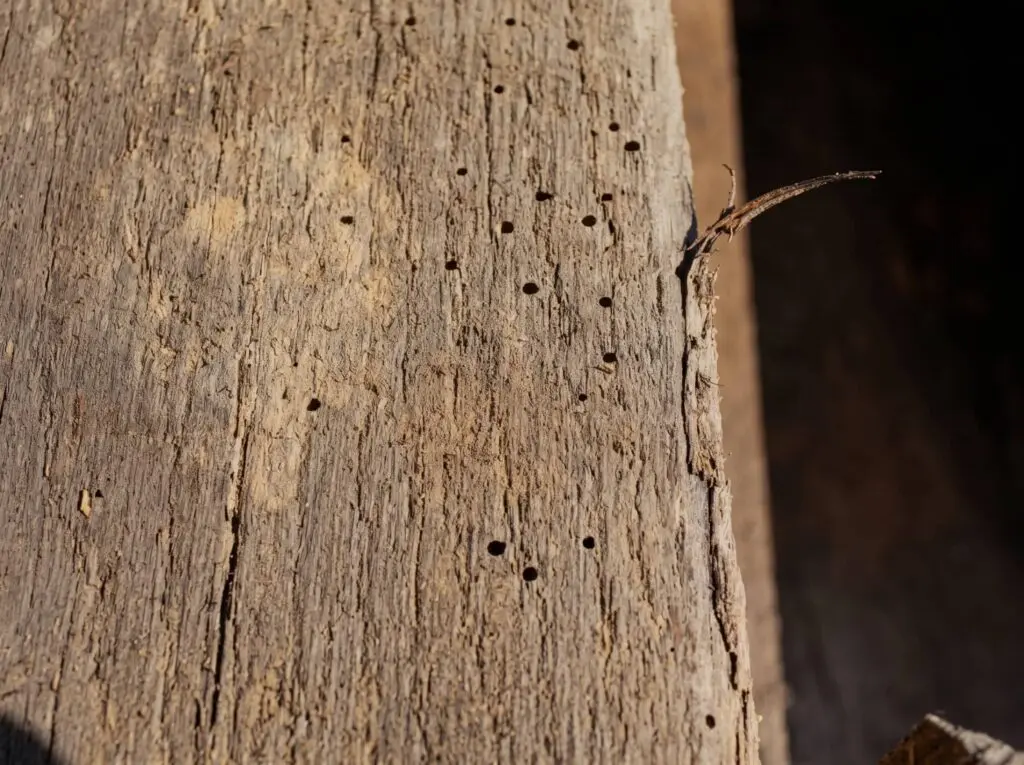
By then the beetle is gone. What is left is a round exit hole and a small pile of powder underneath it, which is where the name comes from: wood reduced to something fine enough to sift through your fingers.
Three families matter in Florida homes, and they are not interchangeable.
The Three Families
| Factor | Lyctidae (true powder post) | Anobiidae (furniture/deathwatch) | Bostrichidae (false powder post) |
|---|---|---|---|
| Wood attacked | Hardwood sapwood only: oak, ash, hickory, walnut, bamboo | Softwoods and hardwoods, including structural timber | Hardwoods, tropical hardwoods, bamboo |
| Attacks pine? | No | Yes | Rarely |
| Exit hole | 1/32 to 1/16 inch | 1/16 to 1/8 inch | 1/8 to 3/16 inch |
| Frass texture | Talc-fine, pours out freely | Gritty, with small pellets | Meal-like, packed tight, rarely falls out |
| Moisture needed | Survives down to 8% | Needs 13% or higher | Varies |
| Life cycle | Under a year in new wood | 2 to 10 years | About a year |
Source: UF/IFAS Extension ENY-266.
In Florida, Anobiidae is the one that damages houses. UF/IFAS identifies anobiid beetles as the family most commonly found in structural timbers. Lyctids show up in furniture, flooring, and trim. That distinction drives everything below.
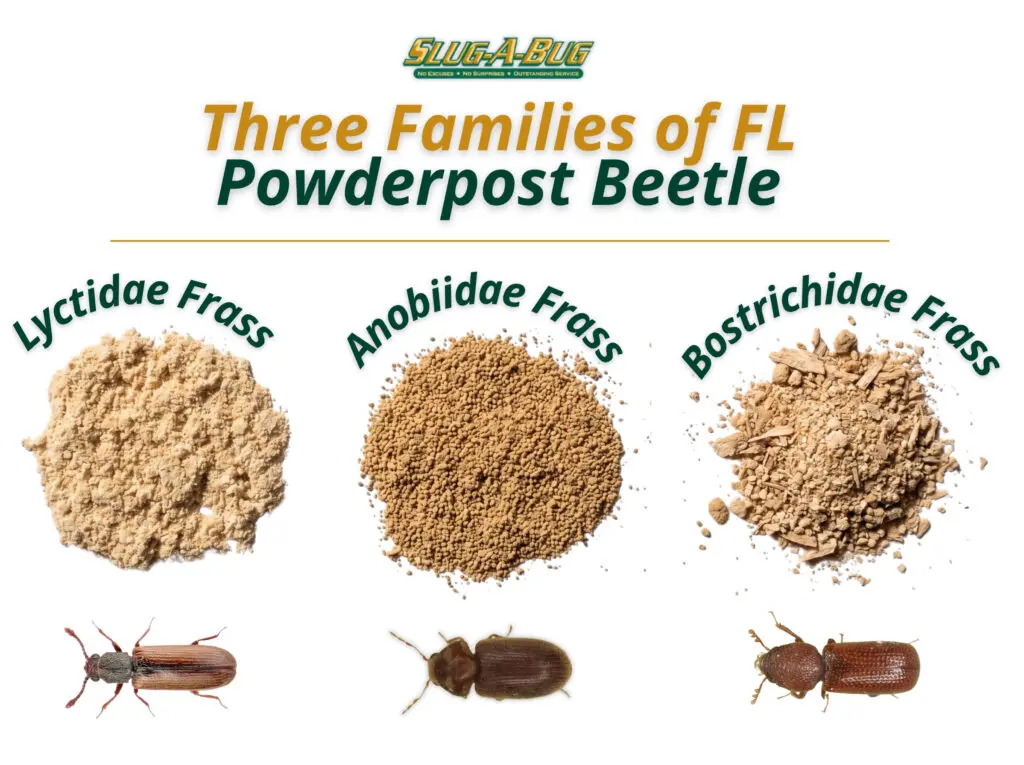
The Frass Test: How to Tell Which One You Have
You do not need to catch a beetle. The powder tells you.
Put a sheet of paper under the holes, tap the wood, and look at what falls.
- Fine as flour or talc, pours out freely. Lyctid. Look at what the wood is: oak trim, a bamboo item, hardwood flooring, a piece of furniture.
- Powdery but gritty, with tiny bun-shaped pellets. Anobiid. This is the structural one, and it means you likely have a moisture problem.
- Packed tight and will not fall out even when you tap. Bostrichid.
Also check whether fresh powder keeps appearing after you clean it up. New frass means an active infestation. Old holes with no new powder may be damage that finished years ago, which matters a great deal when someone is deciding whether to treat.
One more clue: look at what the wood is. If the holes are in pine framing, it is not a lyctid, because lyctids do not attack softwood at all. If they are in an oak table, it very likely is.
Powder Post Beetles or Termites?
Worth ruling out, especially in Florida where drywood termites are common.
| Sign | Powder post beetles | Drywood termites |
|---|---|---|
| Exit holes | Round, clean, pinhead to 3/16 inch | Small kick-out holes, often resealed |
| What falls out | Fine powder or gritty frass | Hard six-sided pellets, larger and more uniform |
| Mud tubes | Never | Subterranean termites, yes |
| Swarmers | Rarely seen | Winged swarmers, often the first sign |
| Damage pattern | Tunnels through sapwood and surface layers | Galleries cut across the grain |
If you are finding hard, uniform pellets rather than powder, you are probably looking at drywood termites, and our guide to why termites are so common in Florida is the better starting point.
How to Prevent Powder Post Beetles
Two tracks, because the two families get in two different ways.
If the risk is Lyctids: control what comes through the door
These beetles rarely infest wood more than five years old. They arrive already inside the material.
- Buy kiln-dried lumber: Kiln drying at 125 to 140°F kills every life stage.
- Inspect hardwood before it goes in: Check trim, flooring, and molding for pinholes and powder at delivery, not after installation.
- Quarantine secondhand furniture and bamboo goods: Antique and imported hardwood pieces are the classic way lyctids enter a home.
If the risk is Anobiids: control moisture
This is the one that matters for Brevard County structures.
- Keep wood below 13% moisture content: That is the documented threshold. Below it, anobiid larvae cannot develop, which is why this single number does more preventive work than anything else on this page.
- Keep indoor relative humidity under about 60%: Properly sized air conditioning and dehumidification do most of this work.
- Watch the unconditioned spaces: UF/IFAS ties anobiid infestations to poorly ventilated crawl spaces, utility rooms, and garages.
A Brevard-specific note: most of the prevention advice you will read online centers on crawl space vapor barriers and foundation vents. Brevard homes are overwhelmingly slab-on-grade, so that advice largely does not apply here. The transferable version is garages, utility rooms, attics, and older coastal or stilt homes, where wood sits in unconditioned humid air year-round.
For both: seal the wood
Powder post beetles lay eggs only on bare, unfinished wood. Paint, varnish, polyurethane, or wax all block egg-laying. Finished furniture and sealed trim are effectively protected, which is why unfinished undersides and backs are where infestations usually start.
Why They Show Up on a WDO Report
Here is the part that catches people during a real estate transaction.
Florida’s wood-destroying organism inspection form, FDACS 13645, defines a WDO as “an arthropod or plant life which damages and can reinfest seasoned wood in a structure, namely, termites, powder post beetles, old house borers, and wood-decaying fungi.”
Powder post beetles are named in the statute’s own language. They are reportable. An inspector who finds active exit holes and fresh frass documents it, and that documentation can delay a closing, trigger a treatment requirement, or reopen price negotiation.
If you are buying or selling in Brevard County, this is worth handling before the inspection rather than after.
Related Questions to Explore
Do powder post beetles damage a house structurally?
Anobiid beetles can, over time. Their life cycle runs 2 to 10 years, so damage accumulates slowly and quietly in floor joists, subflooring, and structural timber. Lyctid beetles attack hardwood items rather than framing, so the damage is usually cosmetic or limited to the affected piece.
Will powder post beetles go away on their own?
Sometimes, and that is what makes them confusing. A lyctid infestation in a single piece of furniture may run its course. Anobiid infestations in structural wood generally will not, because the moisture conditions that allowed them are still there. Fresh frass appearing after you clean it up is the test.
Can I treat powder post beetles myself?
You can seal exposed wood and fix moisture, and both help. What you cannot do at home is treat inside the wood where the larvae actually live, or determine how far an infestation extends. Borate treatments and, in serious cases, fumigation are professional work.
How do I know if the infestation is still active?
Clean out every hole and vacuum up all the powder, then mark the date. Check in a few weeks. New powder means active larvae. No new powder over several months, in Florida’s year-round warm climate, suggests the infestation is finished.
When to Call a Professional
Call us when you are finding fresh frass, when the holes are in structural wood rather than a single piece of furniture, or when you have a WDO inspection coming, and you would rather know now than find out at closing.
Slug-A-Bug has protected Brevard County homes since 1982, and we are the largest independently owned pest management company in the county. We are QualityPro certified through the National Pest Management Association, and both our CEO and our President have served as President of the Florida Pest Management Association.
Powder post beetle work is identification first. Which family, whether it is active, and what moisture condition allowed it. Treating before answering those three questions is how people end up paying twice.
Our pest control services page covers what we handle across Brevard, and DIY approaches to wood-destroying insects explains why store-bought products usually fall short on anything living inside the wood.
Conclusion
- Identify the family first. Lyctids come in with hardwood and furniture. Anobiids are a moisture problem in structural wood, and they are the ones that matter in Florida.
- The frass tells you. Flour-fine and pouring out means lyctid. Gritty with pellets means anobiid. Packed tight means bostrichid.
- They are reportable. Powder post beetles are named on Florida’s WDO form, so they belong on your radar before a real estate inspection, not after.
Finding powder under small round holes? Schedule an inspection with Slug-A-Bug, and we will tell you what you have and whether it is still active.
