
Roof rats in Florida live above you, not below you. They nest in attics, soffits, and the dead frond skirts of palm trees; they travel along branches and power lines to get there, and they can slip through a gap as narrow as half an inch. If you are hearing scratching overhead after dark in Brevard County, this is usually what it is.
The good news is that roof rats are one of the more preventable pest problems in Florida, because the fix is physical rather than chemical. Here is how to confirm what you have and how to keep them out for good.
What Are Roof Rats, and Why Do Floridians Call Them Palm Rats?
Roof rats (Rattus rattus) are also called black rats and, around here, palm rats. Same animal, three names. The palm rat nickname comes from where they nest: the skirt of dead fronds on an untrimmed palm is close to ideal roof rat habitat.
They are smaller and sleeker than the Norway rat most people picture. Adults run about 12 to 14 inches nose to tail and weigh 5 to 10 ounces. They are excellent climbers, active mostly between midnight and dawn, and they will travel a fair distance for food, up to 150 yards from wherever they are nesting.
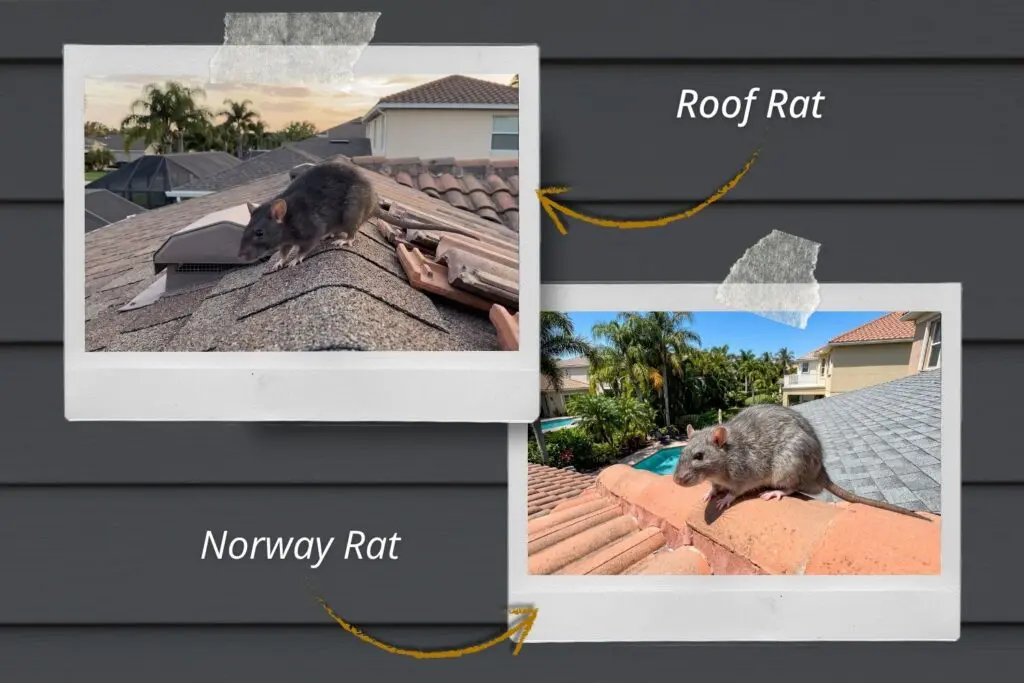
Roof Rat or Norway Rat?
Getting this right matters, because the two species nest in completely different places. Treating a roof rat problem like a Norway rat problem means looking in the wrong half of your house.
| Feature | Roof rat | Norway rat |
|---|---|---|
| Tail | Longer than head and body combined | Equal to head and body |
| Ears and eyes | Large, prominent | Smaller, less prominent |
| Snout | Pointed | Blunt |
| Droppings | About 1/2 inch, spindle-shaped with pointed ends | About 3/4 inch, capsule-shaped with blunt ends |
| Nests | Attics, soffits, trees, palm frond skirts | Underground burrows |
| Food preference | Fruits, vegetables, grain | Nearly anything |
Source: UF/IFAS Extension ENY-224
The tail is the fastest tell if you get a look at one. The droppings are the fastest tell if you do not.
Signs You Have Roof Rats
Roof rats are quiet tenants until they are not. Watch for:
- Scratching or scurrying overhead at night, especially between midnight and dawn. Daytime noise usually means something else.
- Droppings in the attic, along rafters, or on top of insulation. Look for the pointed-end shape described above.
- Gnaw marks on wiring, PVC, or wood in the attic or soffit area.
- Greasy rub marks along beams and pipe runs where they travel the same path repeatedly.
- Shredded insulation or nesting material tucked into corners and voids.
- Fruit hollowed out on the branch. This one is distinctive. Roof rats leave a circular hole about the size of a quarter and eat the inside, leaving the rind hanging on the tree. If you have backyard citrus and you are finding hollow oranges still attached, you have roof rats.
Why Spring and Fall Are Worse in Florida
Most pest content will tell you rodents move indoors when it gets cold. That is a northern story, and it does not apply here.
Roof rats in Florida breed year-round. A female produces 4 or 5 litters a year, 5 to 8 pups each, with a gestation period of only 21 to 23 days. Pups reach breeding age in three to four months.
What does change is intensity. Breeding activity peaks in spring and fall, and the fall peak lines up with citrus ripening. That is why so many Brevard homeowners first notice roof rats between October and January. It is not that the rats arrived. It is that there are suddenly more of them and the food supply moved into your backyard.
How Roof Rats Get In
Two numbers to know.
According to UF/IFAS Extension, rats can squeeze through cracks half an inch wide. The Florida Department of Health puts it another way: a roof rat “only needs a hole the size of a quarter to gain entry.”
Both are true. Half an inch is the narrow slot they can compress through, and a quarter-sized round hole is the everyday version. Either way, the openings that matter are smaller than most homeowners are looking for.
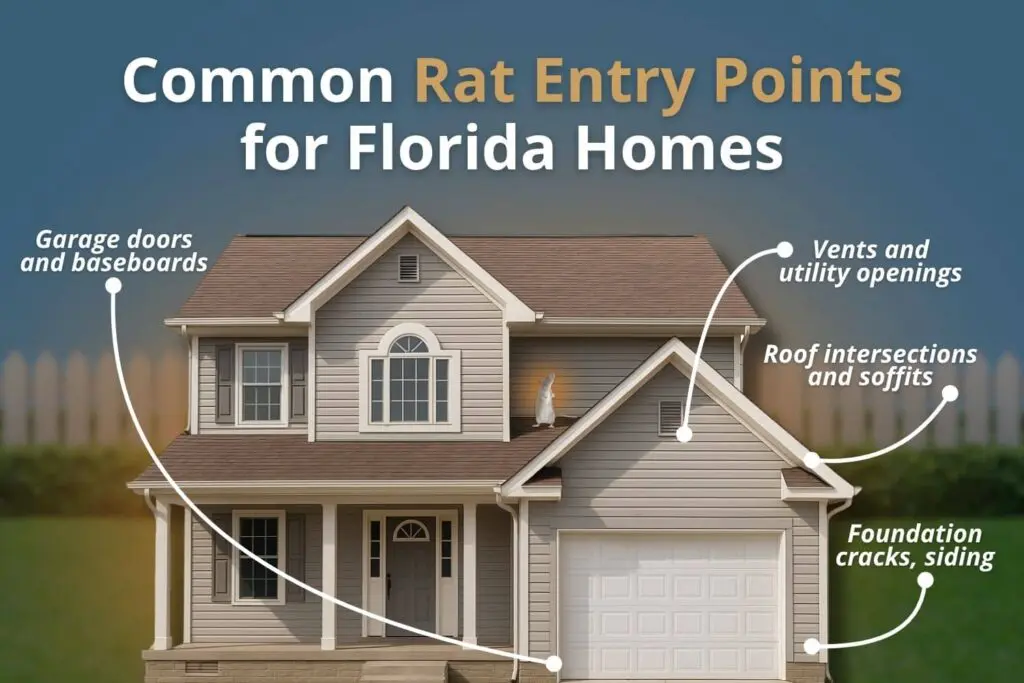
Common entry points on Florida homes:
- Gaps where soffit meets fascia, especially where corrosion has opened seams
- Roof and ridge vents with damaged or missing screening
- Openings around plumbing vents, cable, and A/C line sets
- Barrel tile edges and gaps at the roof line
- Attic gable vents
Getting to those openings is the easy part for them. Roof rats climb overhanging branches, fences, trellises, and utility lines straight onto the roof.
How to Prevent Roof Rats
Prevention is exclusion plus habitat. In that order.
1. Seal every opening. Half an inch or larger gets closed. Use hardware cloth of 19-gauge or heavier with openings no more than a quarter inch, or sheet metal at 26-gauge or heavier. Foam and caulk alone will not hold; rats chew through both.
2. Cut the highways. Trim tree limbs back so nothing overhangs or touches the roof. Fruit trees should stand alone, not touching fences, overhead wires, or the branches of other trees.
3. Strip the palms. Remove the dead frond skirt. It is one of the most reliable roof rat nesting sites in Florida, and it is easy to eliminate.
4. Take away the food. Pick up fallen fruit, secure garbage cans with tight lids, bring pet food in overnight, and take bird feeders down if you have an active problem.
5. Clean up harborage. Woodpiles, dense ground cover, and debris piles against the house all give them cover to stage from.
Why Bait Alone Fails in an Attic
This is the mistake we get called about most, and almost nobody explains it, so here it is plainly.
Bait does not close the hole. You can kill every rat in your attic this month and have a new group in it next month, because the entry point is still open and roof rats range up to 150 yards looking for exactly that opening.
Poisoned rats die where you cannot reach them. A rat that eats bait and then expires inside a wall void or above a ceiling becomes an odor problem and a fly problem, and the only fix is opening the wall.
Roof rats are cautious of new objects. They avoid unfamiliar things in their travel paths, which is why traps need to sit in the same location for at least a week before you judge whether they are working. People move traps after two nights and conclude they do not work.
There are also legal limits worth knowing. Wiring poison bait blocks to tree branches is illegal in Florida. And traps should be set only from dusk to dawn, then closed during the day, so you are not catching birds, squirrels, or a neighbor’s cat.
The Florida Department of Health’s own guidance is to use baits and poisons “only after all other control methods have been used.” Exclusion is the permanent fix. Trapping is cleanup for whatever is already inside.
Related Questions to Explore
Do roof rats carry rabies?
No. CDC surveillance found no rabid rats in the United States between 2011 and 2020, and no human rabies death has ever been linked to a rodent in this country. Roof rats do carry other real risks, including leptospirosis, salmonellosis, rat-bite fever, and flea-borne typhus, which the CDC documents for rodents generally. Rabies is not one of them.
Are palm rats and roof rats the same thing?
Yes. Palm rat, black rat, and roof rat are all common names for Rattus rattus. The palm rat name is a Florida convention and refers to their habit of nesting in the dead frond skirts of palm trees.
How do I know if it is rats or squirrels in my attic?
Timing is the giveaway. Squirrels are active during daylight and tend to be noisy at dawn and dusk. Roof rats run mostly between midnight and dawn. Droppings differ too, since squirrel droppings are rounder and blunter than a roof rat’s pointed, spindle-shaped pellets.
Can I get rid of roof rats myself?
Sometimes, if the infestation is small and you can find and seal every opening. The hard part is not the trapping; it is confirming you found all the entry points. Attic and soffit work in Florida heat, on a tile roof, is also genuinely dangerous. Most homeowners can handle the habitat work and should get help with the exclusion.
When to Call a Professional
Call us when you are hearing activity and cannot find the way in, when you have already tried bait and the noise came back, or when the droppings are in your insulation, and you would rather not be the one up there.
Slug-A-Bug has handled Brevard County rodent work since 1982, and we are the largest independently owned pest management company in the county. We are QualityPro certified through the National Pest Management Association, and both our CEO and our President have served as President of the Florida Pest Management Association.
What that means practically: we treat roof rats as an exclusion job with a trapping component, not a bait-and-hope job. If you want more background first, our guide to common Florida rodents and how they get inside covers the other species we see, and our post on keeping wildlife out of your attic explains how one-way exclusion works.

Conclusion
- Check the tail and the droppings. Roof rats nest above you, Norway rats below. Getting the species right tells you where to look.
- Half an inch is all they need. Seal with hardware cloth or sheet metal, not foam, and cut back every branch touching the roof.
- Bait alone does not solve it. The hole is the problem. Close the hole, and the rats have nowhere to come back to.
Hearing something in the attic? Schedule a rodent inspection with Slug-A-Bug, and we will find out where they are getting in.
